Software /
Faraday
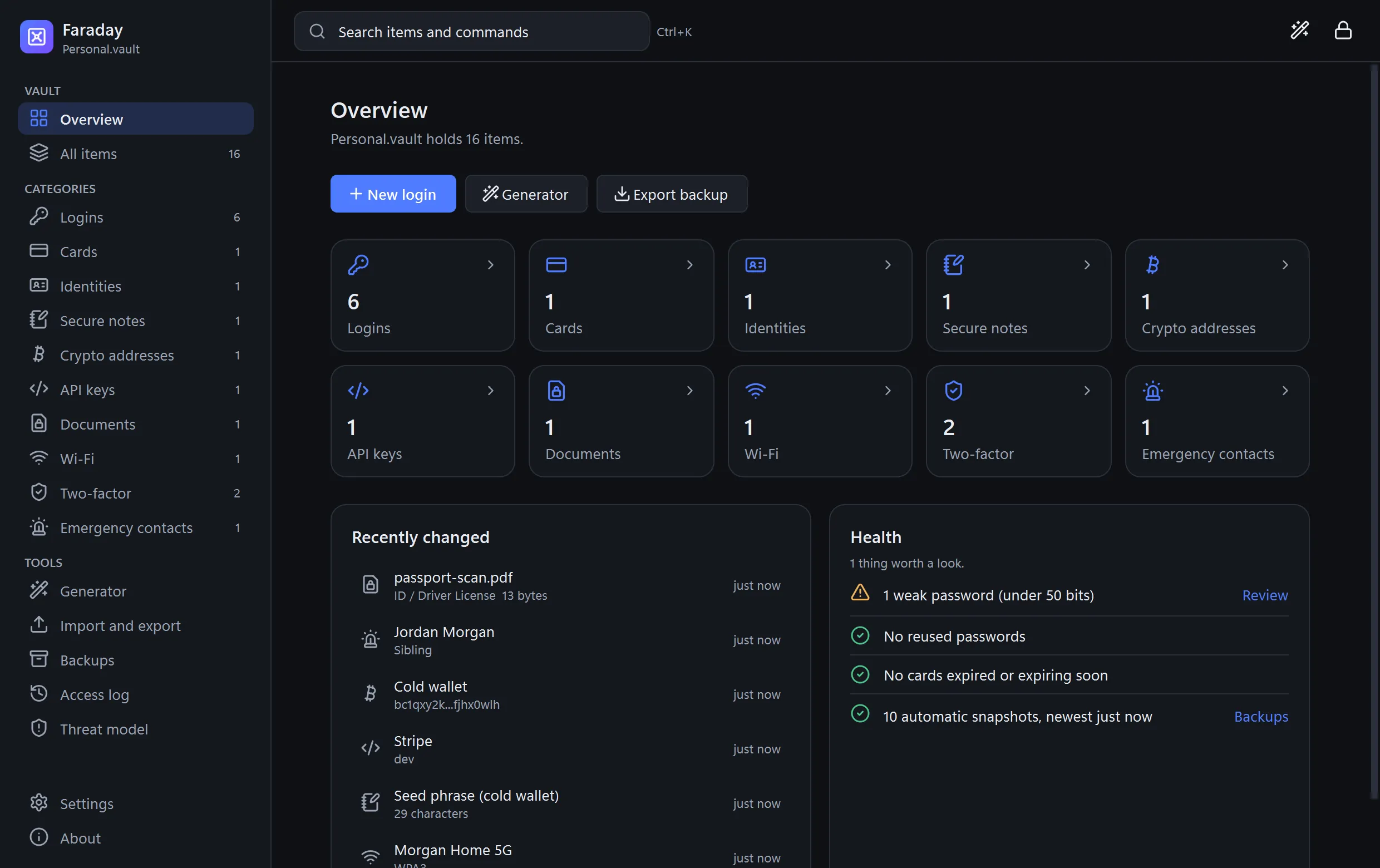
An offline-first vault for passwords, two-factor codes and cryptocurrency addresses. All key derivation and encryption happen on your machine. There are no cloud services, no network calls and no telemetry.
01
What it does
- Keeps logins, notes, cards, identities, two-factor secrets, Wi-Fi records, documents, API keys and crypto addresses.
- Several independent vaults, each with its own key.
- Live two-factor codes for stored authenticator secrets.
- A password and passphrase generator.
- Imports from Bitwarden, KeePass and KeePassXC, and exports to a single password-protected file.
- Locks after an idle time you choose, and when Windows locks or sleeps.
- Keeps an encrypted copy of the previous version before every save.
- A desktop app and a command line.
02
What it needs
- Windows10 or 11 for the download.
- From sourcePython 3.10 or later. Linux and macOS also work this way.
03
How the vault is protected
| Part | What is used |
|---|---|
| Key derivation | Argon2id, with standard, high and maximum levels |
| Encryption | AES-256-GCM, with a unique nonce for each operation |
| File format | CBOR, a binary format |
| Saves | Atomic writes, with rollback on failure |
Cryptographic correctness takes precedence over convenience. The full threat model is in the security policy. Faraday security policy.
04
What it does not protect against
- A compromised operating system, or malware.
- Keyloggers and screen capture software.
- Live memory analysis.
- Social engineering.
06
Source and license
Faraday is MIT.